
Filmfest 551 Cinema
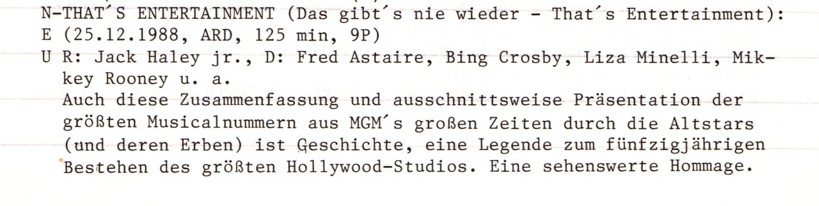
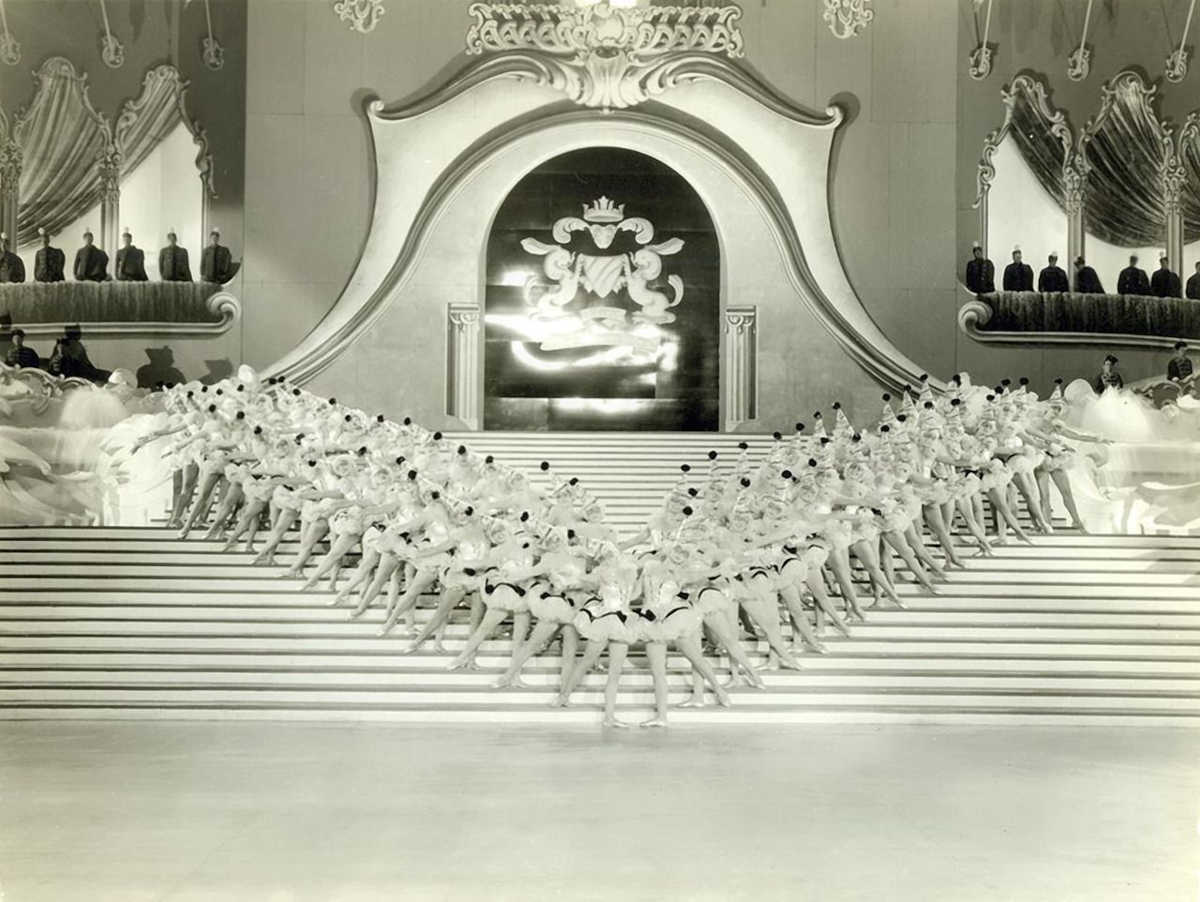
Was ich oben in knappen Worten beschrieben habe, ist nicht mehr und nicht weniger als eine kulminierte Begründung für mein Interesse am Medium Film, basierend auf meiner damaligen Faszination für Muscials. Da darf auch mal ein Ididioten-Apostroph sein, der ja nur der amerikanischen Schreibweise folgt. Schon, als „That’s Entertainment“ herauskam, war der Rückblick auf 50 Jahre Studiogeschichte eine Sicht auf ein abgeschlossenes Kapitel, das in den 1950ern endete. Die schönsten je gefilmten Musiknummern sind in diesem Werk enthalten, aber nur die ca. 90 Prozent davon, die bei MGM entstanden, anders als beim zehn Jahre später aufgelegten „That’s Dancing“, das u. a. unvergessliche Performances wie die von James Cagney in „Yankee Doodle Dandy“ enthält (Warner Bros.):
That’s Entertainment! ist ein amerikanischer Kompilationsfilm aus dem Jahr 1974,der von Metro-Goldwyn-Mayer anlässlich des 50-jährigen Bestehens des Studios veröffentlicht wurde. Der Erfolg der Retrospektive veranlasste 1976 eine Fortsetzung, den dazugehörigen Film That’s Dancing! und eine dritte Folge im Jahr 1994 .
Der Film (…) richtete das Rampenlicht auf MGMs Vermächtnis von Musikfilmen aus den 1920er bis 1950er Jahren, wobei Dutzende von Nummern aus den Filmen des Studios ausgewählt wurden und mit Archivmaterial von Judy Garland , Eleanor Powell , Lena Horne , Esther Williams , Ann Miller , Kathryn Grayson , Howard Keel , Jeanette MacDonald , Cyd Charisse , June Allyson , Clark Gable ,Mario Lanza , William Warfield und vielen anderen ergänzt wurde.
Verschiedene Segmente wurden von einer Reihe legendärer Stars des Studios moderiert: Frank Sinatra , Gene Kelly , Fred Astaire , Peter Lawford , Debbie Reynolds , Bing Crosby , James Stewart , Elizabeth Taylor , Mickey Rooney , Donald O’Connor und Liza Minnelli [ 1] vertritt ihre Mutter Judy Garland .
Inzwischen sind fast weitere 50 Jahre vergangen und ich bin gespannt, ob es etwas zum Hundertjährigen des einst mächtigsten Filmstudios der Welt geben wird. Keiner der Stars aus der großen Ära ist noch am Leben, zu einer ähnlich hochkarätigen Moderation kann es nicht mehr kommen, denn nicht nur diese Menschen, die dem Publikum so viel Freude mit ihrem Können bereitet haben, sind Geschichte, sondern auch die Art der umfassenden Show-Ausbildung, die sie repräsentierten. Kein Kinostar ist heute noch in der Lage, auf hohem Niveau gleichzeitig zu spielen, zu singen und zu tanzen.
Nur wenige der damaligen Musicals gelten heute auch als große kinematografische Würfe, allen voran „Singin‘ in the Rain“ (1952), aber die Nummern aus diesen Filmen sind hinreißend choreografiert und ausgestattet, exzellent performt und ausgeleuchtet und zeigen die Pracht und das damalige Selbstverständnis von MGM als führende Unterhaltungsfabrik der Welt. „Beginning our next 50 Years“ stand im Vorspann des Films zu lesen. MGM hat in der Tat überlebt, aber der deutsche Zusatztitel ist mehr als berechtigt: Das, was in dieser Megashow gezeigt wird, gab es seitdem und wird es nie wieder geben.
© 2021, 1989 Der Wahlberliner, Thomas Hocke
Kursiv und folgende Infos: US-Wikipedia
Ausnahmsweise listen wir anstatt der Besetzung die verwendeten Filmsegmente, einige davon haben Legendenstatus erreicht und sie covern große Teile des American Songbook:
- „Singin‘ in the Rain“ Prologue –
- sung by Cliff Edwards with dancing by Chorus Line; from The Hollywood Revue of 1929 (1929)
- sung by[5] Jimmy Durante; from Speak Easily (1932)
- Judy Garland; from Little Nellie Kelly (1940)
- the main title sequence from Singin‘ in the Rain (1952) sung by Gene Kelly, Debbie Reynolds, Donald O’Connor
- „The Broadway Melody“ – Charles King and Chorus Girls;[6] from The Broadway Melody (1929)
- „Rosalie“ – sung by Chorus with dancing by Eleanor Powell; from Rosalie (1937)
- „Indian Love Call“ – sung by Nelson Eddy and Jeanette MacDonald; from Rose-Marie (1936)
- „A Pretty Girl Is Like a Melody“ – from The Great Ziegfeld (1936)
- sung by Allan Jones (Lip-synced by Dennis Morgan) and Ziegfeld Girls
- „Begin the Beguine“ – dancing by Fred Astaire and Eleanor Powell; from Broadway Melody of 1940 (1940)
- „The Song’s Gotta Come from the Heart“ – danced and sung by Frank Sinatra and Jimmy Durante; from It Happened in Brooklyn (1947)
- „The Melody of Spring“ – sung by Elizabeth Taylor; from Cynthia (1947)
- „Honeysuckle Rose“ – Lena Horne; from Thousands Cheer (1943)
- „Take Me Out to the Ball Game“ – Gene Kelly and Frank Sinatra; from Take Me Out to the Ball Game (1949)
- „Thou Swell“ – June Allyson with Pete Roberts and Eugene Cox (Lip-synced by Ramon Blackburn and Royce Blackburn);[7] from Words and Music (1948)
- „The Varsity Drag“ – dancing by June Allyson, Peter Lawford, and Chorus Line
- „Aba Daba Honeymoon“ – (sung by) Debbie Reynolds and Carleton Carpenter; from Two Weeks with Love (1950)
- „It’s a Most Unusual Day“ – from A Date with Judy (1948)
- sung by Jean McLaren (Lip-synced by Elizabeth Taylor)
- sung by Jane Powell with Wallace Beery, Scotty Beckett, George Cleveland, Leon Ames, Carmen Miranda, Selena Royle, Robert Stack, Elizabeth Taylor and Jerry Hunter[8] featuring the Xavier Cugat Orchestra[9]
- „On the Atchison, Topeka and the Santa Fe“ – Ray Bolger, Judy Garland, Marjorie Main, Ben Carter,[10] Virginia O’Brien, Cyd Charisse,[7] and Ensemble; from The Harvey Girls (1946)
- „It Must Be You“ – dancing by a dance chorus; sung by Robert Montgomery and Lottice Howell;[11] from Free and Easy (1930)
- „Got a Feelin‘ for You“ – dancing by Joan Crawford; sung by Joan Crawford and Chorus[12] (introduced by Conrad Nagel);[13] from The Hollywood Revue of 1929 (1929)
- „Reckless“ – dancing by Jean Harlow, Rafael Alcayde, and Chorus; sung by Virginia Verrill (lip-synced by Jean Harlow) from Reckless (1935)
- „Did I Remember“ – sung by Virginia Verrill (lip-synced by Jean Harlow) and Cary Grant from Suzy (1936)
- „Easy to Love“ – sung by Marjorie Lane (lip-synced by Eleanor Powell) and James Stewart; from Born to Dance (1936)
- „Puttin‘ on the Ritz“ – Clark Gable and Ensemble; from Idiot’s Delight (1939)
- „Dear Mr. Gable (You Made Me Love You)“ – Judy Garland from Broadway Melody of 1938 (1937)
- „Babes in Arms“ – Mickey Rooney, Judy Garland, Douglas McPhail, Betty Jaynes,[7] and Chorus; from Babes in Arms (1939)
- „Hoe Down“ – dancing by Mickey Rooney, Judy Garland, and Ensemble; from Babes on Broadway (1941)
- „Do the La Conga“ – MGM Studio Orchestra; from Strike Up the Band (1940)
- „Waitin‘ for the Robert E. Lee“ – dancing by Chorus; sung by Mickey Rooney and Judy Garland[14]
- „Babes On Broadway“ – dancing by Mickey Rooney and Judy Garland; sung by[14] Mickey Rooney, Judy Garland, Virginia Weidler, and Richard Quine; from Babes on Broadway (1941)
- „Strike Up the Band“ – sung by[15] Mickey Rooney, Judy Garland, and Chorus; from Strike Up the Band (1940)
- „The Babbitt and the Bromide“ – dancing by Gene Kelly and Fred Astaire; from Ziegfeld Follies (1946)
- „They Can’t Take That Away from Me“ – dancing by Fred Astaire and Ginger Rogers; sung by Fred Astaire; from The Barkleys of Broadway (1949)
- „Heigh Ho the Gang’s All Here“ and „Let’s Go Bavarian“ – danced and sung by Fred Astaire, Joan Crawford, and Chorus; from Dancing Lady (1933)[16]
- „I Guess I’ll Have to Change My Plan“ – danced and sung by Fred Astaire and Jack Buchanan; from The Band Wagon (1953)
- „Sunday Jumps“ – dancing by Fred Astaire; from Royal Wedding (1951)
- „Shoes with Wings On“ – dancing by Fred Astaire; from The Barkleys of Broadway (1949)
- „You’re All the World to Me“ – danced by Fred Astaire; from Royal Wedding (1951)
- „Dancing in the Dark“ – dancing by Fred Astaire and Cyd Charisse; from The Band Wagon (1953)
- Esther Williams Montage:
- „Pagan Love Song“ – sung by Chorus; from Pagan Love Song (1950)[17]
- „You and You“ (aka „Du und Du, Op. 367“) – from Bathing Beauty (1944)
- „Viennese Blood“ (aka „Wiener Blut, Op. 354“)
- also includes water ballets from Million Dollar Mermaid (1952)
- „I Wanna Be Loved by You“ – sung by Helen Kane (lip-synced by Debbie Reynolds) and Carleton Carpenter; from Three Little Words (1950)
- „I Gotta Hear That Beat“ – danced and sung by[18] Ann Miller; from Small Town Girl (1953)
- „Be My Love“ – sung by Kathryn Grayson and Mario Lanza; from The Toast of New Orleans (1950)
- „Make ‚Em Laugh“ – sung by[19] Donald O’Connor; from Singin‘ in the Rain (1952)
- „Cotton Blossom“ – sung by Chorus
- „Make Believe“ – sung by Kathryn Grayson and Howard Keel
- „Ol‘ Man River“ – sung by William Warfield and Chorus; from Show Boat (1951)
- „By Myself“ – Fred Astaire from The Band Wagon (1953)
- „Be a Clown“ – dancing by Gene Kelly & The Nicholas Brothers; sung by Gene Kelly;[20] from The Pirate (1948)
- „The Children’s Dance“ – Gene Kelly; from Living in a Big Way (1947)
- „The Pirate Ballet“ – dancing by Gene Kelly; from The Pirate (1948)
- „La Cumparsita“ – Gene Kelly; in Anchors Aweigh (1945)
- „New York, New York“ – danced and sung by[21] Gene Kelly, Frank Sinatra, and Jules Munshin; from On the Town (1949)
- „The Worry Song“ – dancing by Gene Kelly and Jerry Mouse; sung by Gene Kelly & Sara Berner;[22] from Anchors Aweigh (1945)
- „Broadway Melody Ballet“ – Gene Kelly and Ensemble; from Singin‘ in the Rain (1952)
- „In the Good Old Summertime“ – sung by Chorus; from In the Good Old Summertime (1949)
- „La Cucaracha“ – The Garland Sisters; from La Fiesta de Santa Barbara (1935)
- „Waltz with a Swing“ – Judy Garland
- „Americana“ – Judy Garland and Deanna Durbin; from Every Sunday (1936)
- „Your Broadway and My Broadway“ – dancing Judy Garland, Buddy Ebsen, Eleanor Powell, and George Murphy;[23] from Broadway Melody of 1938 (1937)
- „You’re Off to See the Wizard“ – The Munchkins
- „If I Only Had the Nerve“ – Judy Garland, Bert Lahr, Ray Bolger, Jack Haley and Buddy Ebsen[24]
- „We’re Off to See the Wizard“ – Judy Garland, Bert Lahr, Ray Bolger and Jack Haley and Buddy Ebsen[24]
- „Over the Rainbow“ – Judy Garland; from The Wizard of Oz (1939)
- „But Not for Me“ – Judy Garland from Girl Crazy (1943)
- „The Trolley Song“ – sung by[25] Judy Garland and Chorus
- „Under the Bamboo Tree“ – danced and sung by[25] Judy Garland and Margaret O’Brien
- „The Boy Next Door“ – sung by[25] Judy Garland; from Meet Me in St. Louis (1944)
- „Get Happy“ – Judy Garland & Chorus; from Summer Stock (1950)
- „Going Hollywood“ – Bing Crosby and Ensemble; from Going Hollywood (1933)
- „Well, Did You Evah“ – Bing Crosby and Frank Sinatra
- „True Love“ – Bing Crosby and Grace Kelly; from High Society (1956)
- „Hallelujah“ – sung by Kay Armen, Ann Miller, Jane Powell, Debbie Reynolds, Vic Damone, Russ Tamblyn, Tony Martin,[26] and Chorus; from Hit the Deck (1955)
- „Barnraising Dance (Bless Your Beautiful Hide)“ – dancing by various characters; from Seven Brides for Seven Brothers (1954)
- „Gigi“ – sung by Louis Jourdan
- „Thank Heaven for Little Girls“ – sung by Maurice Chevalier and Chorus; from Gigi (1958)
- „An American in Paris Ballet“ – dancing by Gene Kelly, Leslie Caron, and Ensemble; from An American in Paris (1951)
Entdecke mehr von DER WAHLBERLINER
Melde dich für ein Abonnement an, um die neuesten Beiträge per E-Mail zu erhalten.


 DER WAHLBERLINER